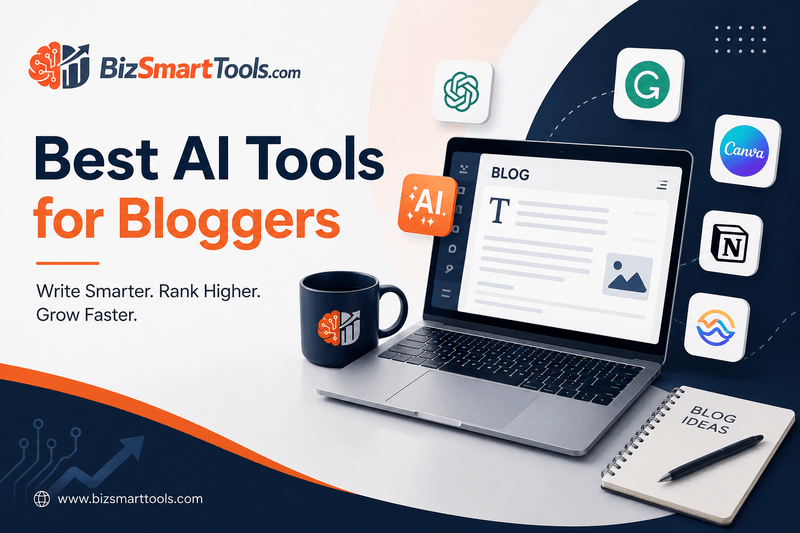
Blogging in 2026 is a pipeline: research, positioning, SEO, editing, publishing, and promotion on a steady cadence. The best AI tools for bloggers remove friction—they do not replace your voice.
Whether you run a niche site, WordPress magazine, or freelance client blog, AI earns a place when it saves repeatable work:
- Keyword lists turned into outlines and briefs
- Intros, meta descriptions, and FAQ blocks drafted faster
- Social snippets and email angles generated from published posts
- Competitor headings benchmarked before you write
This guide maps 25+ AI blogging tools to those jobs, with live BizSmartTools profiles across the AI tools category.
You will see the same patterns as our other long-form guides—summary callouts, comparison grids, pricing tables, stack cards, and verdict blocks. Terms like AI blogging tools, AI SEO tools, and best AI content tools all describe one decision: which app earns a recurring slot in your editorial system.
For a fast orientation before the deep dives, use the quick summary below, then jump to the comparison grid for best AI tools for bloggers side by side.
Quick Summary
Top AI Tools for Bloggers in 2026
The comparison grid compares leading AI blogging tools on fit, free access, typical paid entry, and editorial rating. Cards pull names, ratings, and pricing labels from the same JSON profiles used across BizSmartTools—open a full review without hunting for stale list prices.
How to read this comparison:
- Free plan — whether you can test workflows without paying (limits still apply).
- Starting price — shown on each card’s pricing badge; confirm on the profile before checkout.
- Rating — editorial score on the card; not a guarantee of fit for your niche.
Summary of top recommendations:
Start with one AI assistant—ChatGPT, Claude, or Gemini—and standardize outlines, drafts, and repurposing there before you add niche apps. ChatGPT fits bloggers who want the broadest plugin and custom GPT ecosystem; Claude is often chosen for long-form structure, careful rewrites, and nuanced tone; Gemini is a strong pick when you already live in Google Docs and want a capable free tier for light publishing.
Add Perplexity when you need reliable, cited research—stats, competitor angles, and trend checks—before claims land in your draft. Perplexity validates facts; it is not a replacement writer, but it shortens the tab-heavy research phase that slows many bloggers down.
Layer Surfer SEO when you publish on a schedule for search (for example weekly) and track impressions in Search Console. Without that feedback loop, on-page optimizers become expensive spell-checkers; with it, Surfer helps align headings, coverage, and length with pages that already rank.
Use Grammarly for grammar, tone, and publish-time proofreading so AI drafts still sound like you—especially intros, conclusions, and affiliate disclosures readers skim first. Pair it with Canva for featured images, pins, and social creatives so posts earn clicks from search and social; Magic Studio on Pro plans keeps new bloggers on-brand without hiring a designer.
How beginners should build an AI stack: treat the comparison grid as a menu, not a shopping list. Run one assistant for a month, add Perplexity when research bottlenecks appear, add Surfer when organic traffic is a measured goal, then add Grammarly or Canva for polish—build gradually instead of subscribing to every tool at once.
Profile cards in the grid show live ratings and starting prices from the same BizSmartTools profiles used across the site—open each card for full reviews, feature lists, and checkout links before you buy.
Ratings and starting prices are sourced from BizSmartTools profiles where available and may change over time. Vendors without profiles show directional vendor pricing only. Always verify the latest pricing, free-tier limits, and trial terms on each profile or vendor site before purchasing.
Tools without BizSmartTools profiles in this grid still belong on your shortlist when those jobs matter—compare them to profiled tools on intent and workflow, not hype alone.
Choose tools based on your workflow rather than buying everything. Most bloggers can start with one AI assistant, one SEO tool when search traffic is a goal, and one design or proofreading tool—then compare finalists on BizSmartTools profiles and VS pages before checkout.
List prices come from BizSmartTools profiles where available; vendors without profiles show directional vendor pricing only.
Most bloggers do not need every row. A practical rule:
- One assistant for drafting and repurposing
- One SEO layer once you publish weekly and track Search Console
- One polish tool (grammar or design) before video or niche research apps
Assistants differ in tone, context limits, and integrations—not just benchmark scores.
- Claude — tutorials and nuanced rewrites
- Gemini — research and drafts in Google Docs
- ChatGPT — widest plugin and custom GPT ecosystem
- Perplexity — validate claims before they enter your draft (not a replacement writer)
SEO tools belong in the stack when you publish on a schedule and measure impressions in Search Console. Without that loop, optimizers become expensive spell-checkers.
Marketing writers such as Jasper and Writesonic earn their seat when you ship comparisons, landing pages, and email weekly—not for monthly essays alone.
Focus on four questions before you add another subscription:
When a tool passes those checks, open its BizSmartTools profile, compare finalists on VS pages, or start with dedicated roundup pages such as ChatGPT alternatives and Claude alternatives when you are narrowing a shortlist.
Best AI Tools by Blogging Category
Category beats hype when you are choosing AI writing tools, AI SEO tools, and production apps. The sections below explain when each group earns a line item in your budget, with profile cards for tools we track in the directory.
Best AI Stack for New Bloggers
Stacks should match revenue stage—not every tool on day one. The cards below mirror how we present business-type stacks in our best AI tools for small business guide, adapted for AI tools for content creators and publishing workflows.
What each stack optimizes for:
- Budget stack — prove publishing habit and voice before paid SEO suites.
- Growing bloggers — weekly posts, rankings, and cited research.
- Professional bloggers — revenue-scale SEO, multimedia, and team seats.
Revisit stacks every quarter. Cancel duplicate assistants, and upgrade only when limits block publishing or revenue tasks.
Budget stack bloggers should keep drafts in Google Docs or WordPress—AI for outlines and light edits, not full autopublish.
Growing bloggers should document a brief template in Notion AI with H2 rules, internal link targets, and CTA placement.
Professional bloggers should run Semrush or Surfer SEO as part of editorial QA before every major post.
Affiliate monetization rules:
- Keep disclosure language human-written
- Store tested product notes outside chat threads
- Use AI for structure, not manufacturer copy-paste
AI Pricing Comparison
Plans change often—use profile cards for live badges. The comparison table below summarizes free plan availability and typical fit; confirm Starter and Business tiers on each profile before checkout.
When you compare rows, ask two questions: Who publishes with this tool daily? and What breaks if you hit the cap? A hobby blogger may stay on free assistant tiers longer than a weekly publisher running SEO analyses on every post.
Paid marketing and SEO tools often anchor spend faster than assistants. Notion AI is a paid add-on to an existing workspace—worth it when your editorial calendar already lives in Notion. Jasper and Writesonic usually anchor spend earlier than a single general assistant.
Treat “free plan” rows as directional. Limited tiers may cap models, exports, or analyses; paid tiers bundle seats and support.
Tier patterns bloggers usually see:
- Free — Model caps, word limits, or watermarks; fine for testing voice and workflow.
- Starter — Higher limits, basic brand or SEO features, single-seat focus (e.g. Plus, Pro, Premium, Essential).
- Business — Team seats, compliance, integrations, and priority support.
Typical paid entry points (confirm on each profile): ChatGPT Plus ~$20/mo; Claude Pro ~$20/mo; Gemini Advanced ~$19.99/mo; Perplexity Pro ~$20/mo; Surfer SEO Essential ~$79/mo; Jasper Creator ~$39/mo; Grammarly Premium ~$12/mo; Canva Pro ~$15/mo; Notion AI add-on ~$10/mo; Writesonic Individual ~$16/mo; Copy.ai Pro ~$36/mo; Rytr Saver ~$9/mo; Semrush Pro ~$140/mo. Team and Business tiers vary by seat count—open each profile before renewal.
Starter tiers unlock higher word limits, more SEO analyses per month, and brand kits in design tools. Business tiers matter when VAs or editors need shared workspaces.
Solo bloggers often stay on Starter or Plus plans 12+ months if they cancel overlap—two assistants plus two SEO suites rarely both earn their keep.
Best AI Tools by Use Case
Use cases cut across tools. Match the job first, then pick software.
Starting a Blog
Primary tools: ChatGPT or Gemini, Canva, Grammarly.
- Validate niche angles and title lists with an assistant
- Build a simple visual identity in Canva before post one
- Run cornerstone drafts through Grammarly before publish
Growing Organic Traffic
Primary tools: Surfer SEO or Semrush, plus Perplexity.
- Build briefs from keywords that already have impressions
- Score drafts against SERP competitors before go-live
- Use cited research for stats and comparison tables
Affiliate Blogging
Primary tools: Claude or ChatGPT for structure; human testing for claims.
- Generate comparison outlines and FAQ scaffolds only
- Never paste manufacturer marketing copy
- Log hands-on notes and screenshots outside AI chats
Freelance Blogging
Primary tools: Notion AI or ClickUp, Grammarly, Jasper for client brand rules.
- Separate workspaces per client
- Store approved tone examples in the project hub
- Deliver with a consistent editing pass every time
Niche Blogging
Primary tools: NotebookLM, Perplexity, plus your chosen assistant.
- Upload source PDFs and papers to NotebookLM first
- Verify fast-moving facts with cited search
- Translate technical sources into approachable posts
WordPress Blogging
Primary tools: Assistants for drafts, Surfer SEO, Canva.
- Draft outside the block editor if that improves focus
- Optimize on-page elements before hitting Publish
- Plan internal links manually or via your SEO plugin checklist
Content Repurposing
Primary tools: ChatGPT for scripts; CapCut AI or Descript for video.
- One blog post → email, social, and Shorts outlines
- Link Shorts and videos back to the canonical URL
- See best AI tools for content creators for multi-channel stacks
Email Newsletter
Primary tools: Assistants for subject lines; dedicated ESP for sending.
- Generate subject line variants and summary blurbs
- Do not store subscriber lists in AI chat logs
- Keep compliance and unsubscribe flows in your email tool
Social Media Promotion
Primary tools: Canva plus an assistant for hooks.
- Carousels from key post takeaways
- Test three hooks; keep what earns clicks
- Automate only after a format wins twice
YouTube Blogging
Primary tools: Claude for scripts; CapCut AI or Descript for edits.
- Script from the blog outline for consistency
- Caption and clip for Shorts with link in description
- Use the blog as the canonical, indexable source
Across use cases: AI accelerates production; strategy stays human. Pick one keyword and one CTA per post, then document prompts when a workflow repeats three weeks in a row.
Freelancers: never paste confidential briefs into shared team accounts. Niche bloggers: log sources in NotebookLM or Notion. WordPress publishers: still check mobile layout and Core Web Vitals—AI does not fix slow themes.
Pros & Cons
AI blogging tools reward disciplined editing. Below is a quick balance check before you expand your stack.
Common Mistakes Bloggers Make
Avoid these publish-day failures—they are more common than model choice mistakes.
Treat this checklist as a pre-publish gate. The bloggers who win with AI are not the fastest generators—they are the most consistent editors. Run important intros and conclusions through Grammarly or explore Grammarly alternatives if you need tone controls your assistant does not offer. Build a five-minute final pass: read aloud, check one stat, add one personal sentence, confirm one internal link, and proof the opening and closing paragraphs.
When Should Bloggers Start Using AI?
Start when you have a niche and a publishing goal—not when you have every tool on a wish list.
Beginners: free assistants plus grammar; learn prompts and editing discipline. Pair with best AI tools for students if budget is tight.
Intermediate: add cited research and SEO when traffic matters more than volume alone.
Professionals: plan across optimization, multimedia, and team seats when content pays the bills.
Readiness trigger: five or more hours per week on tasks AI already does well (outlines, meta, snippets, image variants). Pilot one paid tool for 30 days—stay on free tiers if savings do not beat subscription cost at your hourly rate.
Plan roughly 40% generation / 60% human refinement for posts you want to rank.
Final Verdict
One tool in 2026: ChatGPT for breadth. Add specialists as cadence and revenue grow:
- Claude — length and rewrite quality
- Surfer SEO — rankings
- Perplexity — citations
- Canva — CTR from visuals
- Gemini — tight budgets
Ready to compare vendors side by side? Explore additional AI tool comparisons on BizSmartTools—start from the AI tools category, open profile cards for live pricing, and use VS pages plus alternatives roundups when two tools look similar on paper.
Related Reading
Before you jump to the FAQ below, these guides and roundups pair well with a blogger stack:
- Best AI tools for small business — overlap when your blog supports a company site, client services, or founder-led brand.
- Best AI tools for students — lean stacks and free-tier tactics when budget is the main constraint.
- Best AI tools for marketing — campaign cadence, landing pages, and brand voice beyond editorial posts.
- Best AI tools for content creators — video, social, and repurposing workflows that extend a blog into other channels.
- Grammarly alternatives — editing and tone tools when proofreading is your bottleneck.
- Browse all AI tools — filter profiles by pricing, category, and use case across the directory.